
Guides
6 Months Study Plan for IPMAT
Mohit Kumar Rajora · 9 October 2026

Six months feels impossibly short when you first look at the IPMAT syllabus. Quant, verbal ability, and strict sectional cut-offs can pile up fast once you start reading past papers. Many Class 11 and 12 students wonder if they're already too late to start. The truth is, timing matters less than how deliberately you use it.
A 6 months study plan for IPMAT works when it's anchored to the real exam date and broken into clear phases instead of vague daily goals. The Integrated Program in Management Aptitude Test, or IPMAT, is the entrance exam for the five-year integrated management programs at IIM Indore and IIM Rohtak. This guide walks through the exact exam pattern you're preparing for, a month-by-month roadmap from foundation-building to mock-test marathons, a workable daily schedule, and the mistakes that quietly derail otherwise strong candidates.
Once you see the full roadmap laid out, six months will feel like exactly enough time to get this right. Let's start with the exam itself.
Key Takeaways
Anchor your 6 month timeline to IPMAT Indore's actual exam date in early May, not to January 1st or a random start date.
Follow a three-phase approach: foundation building, intensive timed practice, and a full mock-test marathon.
Sectional cut-offs matter more than your overall score, since every section must clear its own bar independently.
Verbal Ability deserves equal or greater focus than Quant, given its historically higher sectional cut-off.
Deep mock analysis, not mock quantity, drives the biggest score jumps during the final two months.
What Is The IPMAT Exam Pattern You're Preparing For?
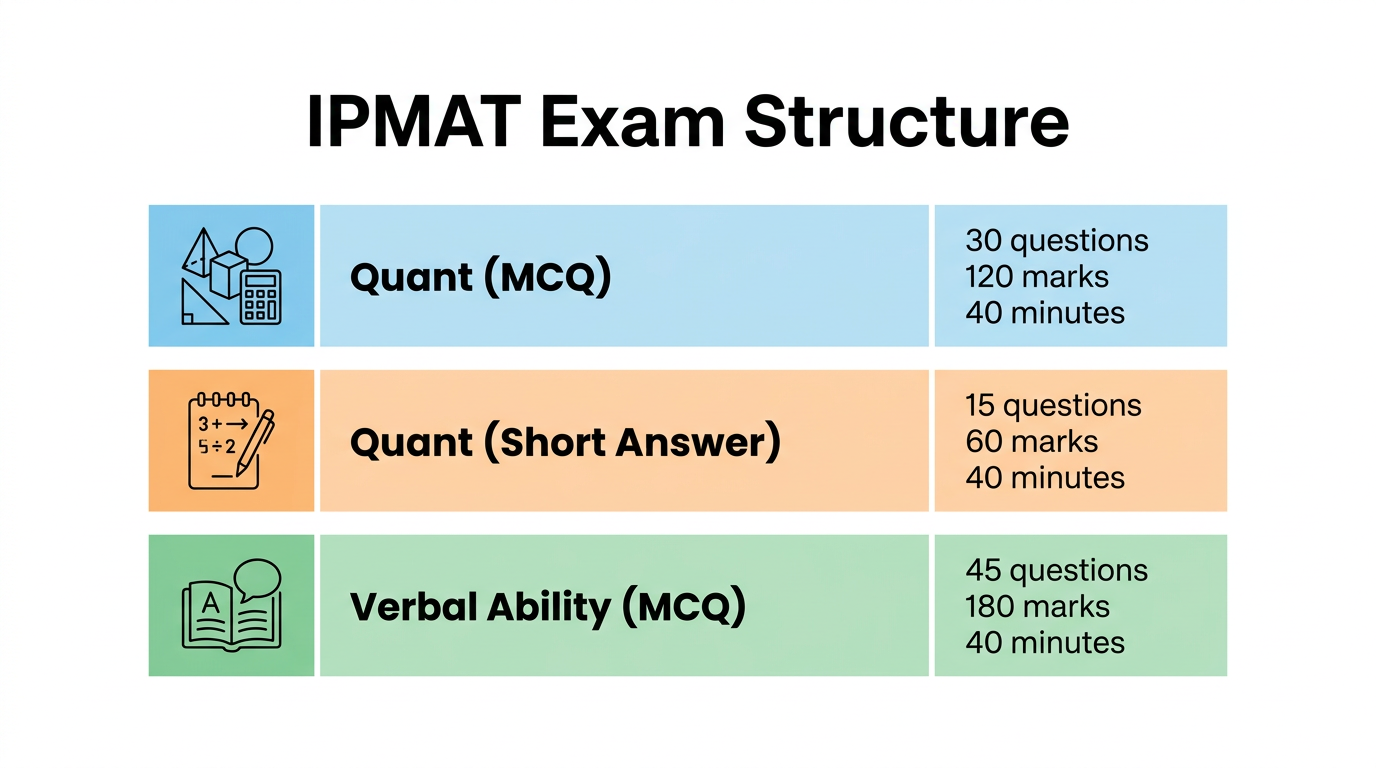
The IPMAT exam pattern splits 120 minutes across three sections, two in quantitative ability and one in verbal ability, all attempted in a fixed, non-negotiable order. You can't borrow extra minutes from one section to rescue another once the timer starts. Correct MCQ answers earn 4 marks each, with a 1-mark penalty for wrong guesses, while the short-answer (TITA) quant section carries no negative marking at all, making it a genuine scoring opportunity.
Section | Questions | Marks | Time |
|---|---|---|---|
Quant (MCQ) | 30 | 120 | 40 min |
Quant (Short Answer) | 15 | 60 | 40 min |
Verbal Ability (MCQ) | 45 | 180 | 40 min |
Clearing the overall score isn't enough to reach the interview stage. IPMAT Indore applies sectional cut-offs, so a brilliant quant score can't make up for a verbal ability score that falls short. Historical cut-off trends put Verbal Ability's threshold noticeably higher than either quant section, which is exactly why this study plan treats verbal ability as a priority rather than an afterthought.
How Should You Plan Your First Two Months (Foundation Phase)?

The first two months of your IPMAT preparation strategy exist to build genuine conceptual clarity across quant and verbal ability, not to chase speed too early. Rushing into mock tests before concepts settle often causes panic later, when timing pressure exposes shaky basics. This foundation phase trades intensity for consistency, with 3 to 4 hours of focused daily study split across both subjects as part of your broader IPMAT syllabus coverage.
Month 1: Building Core Concepts
Month 1 centers on NCERT-level arithmetic, ratios, percentages, and basic algebra, with one hour daily spent solving problems for understanding rather than speed. Build a formula notebook as you go, since it becomes your fastest revision tool later in the year. On the verbal side, read The Hindu or Indian Express editorials for 30 to 45 minutes daily, and add ten new vocabulary words with example sentences every day. Toss in a few simple seating-arrangement puzzles too, since early reasoning skills development pays off once the exam mixes question types together.
Month 2: Widening Topic Coverage
Month 2 pushes quant into permutations, probability, and functions, while introducing Vedic math shortcuts that shave seconds off calculations. Practice 25 to 30 questions per topic before moving on, so mastery replaces mere familiarity with the material. Verbal ability work should now include timed reading comprehension passages and para-jumbles, alongside continued daily reading and vocabulary building. This is also a good point to start logging scores, so weak spots in your IPMAT quantitative aptitude preparation become visible before they turn into bigger gaps.
How Do You Build Speed And Accuracy In Months 3-4?
Months 3 and 4 shift your IPMAT exam preparation timeline from learning concepts to applying them under a running clock, since the actual test rewards speed almost as much as knowledge. Daily targets get noticeably heavier now, covering:
50-plus mixed quant questions
Two reading comprehension passages
4 to 5 data interpretation or reasoning sets
A mistake journal matters a lot here, logging exactly why each wrong answer went wrong instead of just noting the score.
Month 3: Intensive Timed Practice
Month 3 introduces two sectional tests every week, one for quant and one for verbal, each followed by immediate review rather than a quick glance at the final score. Start timing every single practice set from this point onward, with no exceptions, as part of your IPMAT time management toolkit. Speed matters, but never at the cost of accuracy, since careless errors under time pressure cost exactly as many marks as not knowing the answer at all.
Month 4: Previous Papers And Mixed Practice
Month 4 brings in full previous year IPMAT papers, ideally spanning 2019 through 2025, to reveal recurring question types and difficulty patterns newer material often misses. Mixed-topic question sets, rather than single-topic drills, now mirror the unpredictability of actual exam day. Keep reviewing formulas and grammar rules daily too, since intensive practice weeks are exactly when older concepts quietly start slipping away.
What Does The Mock Test Marathon In Months 5-6 Look Like?
Months 5 and 6 turn your IPMAT study schedule into a genuine mock test marathon, where full-length exams replace isolated topic drills. Mock frequency ramps from 2 to 3 attempts weekly in Month 5 up to 5 or 6 weekly by the final month. Spend roughly double the exam's own time analyzing each mock, since a two-hour test deserves close to four hours of review, and this habit alone drives most real IPMAT score improvement.
Month 5: Full-Length Mock Integration
Month 5 means sitting every mock under strict exam conditions, one 120-minute block, sections attempted in the fixed order IPMAT mandates, with no chance to revisit a section once it's closed. Use this month to experiment with the order you attempt questions within each section, since some students do better tackling easier ones first while others prefer the tough ones while mentally fresh. Track exactly where accuracy drops and which question types quietly eat time without paying off in marks.
Month 6: Final Revision And Mental Readiness
Month 6 narrows revision down to the highest-yield topics only, algebra and arithmetic in quant, reading comprehension and critical reasoning in verbal, since new topics this late rarely pay off. Protect 7 to 8 hours of sleep nightly and add light exercise or a short walk to manage exam-week nerves. Avoid starting anything unfamiliar in the final two weeks, and instead lean on your formula notebook, mistake journal, and one or two lighter mock run-throughs to close out preparation with confidence.
What Daily Study Schedule And Resources Actually Work?

A workable daily routine for IPMAT splits your hours across quant, verbal, and reasoning practice instead of burying yourself in one subject for hours at a stretch. A reasonable daily split looks like:
2 to 2.5 hours on quant
2 hours on verbal ability
45 minutes of editorial reading
1 hour of focused reading comprehension practice
1 to 1.5 hours for daily revision and planning
Previous year papers deserve a slot twice a week on top of this routine, and students weighing IPMAT coaching programs alongside self-study should check whether a program's mock quality and mentoring actually match this kind of daily structure.
A handful of IPMAT books and resources consistently show up in successful study plans.
How to Prepare for Quantitative Aptitude for CAT by Arun Sharma maps closely to IPMAT's quant difficulty and offers more problem variety than basic school-level books like R.S. Aggarwal's texts.
Word Power Made Easy by Norman Lewis builds vocabulary through word families rather than rote lists, directly supporting your verbal ability preparation.
High School English Grammar & Composition by Wren & Martin covers the grammar fundamentals IPMAT verbal questions test again and again.
Nishit Sinha's reasoning books add useful data interpretation practice, which still shows up inside IPMAT Indore's quant and verbal sections despite there being no standalone reasoning paper.
What Mistakes Can Derail Your 6-Month IPMAT Plan?

A handful of avoidable mistakes quietly wreck even well-intentioned preparation.
Delaying mock tests until Month 5 or 6 leaves no runway to fix the weak spots those mocks reveal.
Overemphasizing quant because it feels more concrete than verbal ability is another classic trap, especially given verbal's higher cut-off.
Confusing IPMAT Indore's pattern with IPMAT Rohtak's, which includes a standalone logical reasoning section, wastes real preparation hours on content that won't appear on your actual exam.
Tip: Review every mock the same day you take it, while the mistakes are still fresh in your mind. Waiting even a day or two blurs the exact reasoning behind each wrong answer.
The Takeaway
Six months is genuinely enough time to crack IPMAT, provided you treat it as three disciplined phases instead of one long blur of studying. Foundation-building earns you concepts, intensive practice earns you speed, and the mock marathon earns you exam-day composure. Sectional cut-offs, especially verbal ability's higher bar, deserve attention throughout, and a handful of deeply analyzed mocks will teach you more than a dozen rushed ones ever could.
Start today, anchor your plan to IPMAT Indore's exam date, and let Month 1 begin now instead of next week. Open your formula notebook, start a fresh vocabulary list, and take the first small step toward the score your preparation deserves.
Frequently Asked Questions
When Should I Start A 6-Month IPMAT Study Plan If The Exam Is In May?
Start around November so your foundation, practice, and mock-test phases line up with IPMAT Indore's typical early-May exam date. Starting later compresses your timeline, while starting earlier simply gives you a longer foundation phase before the mock marathon begins.
Is 6 Months Enough For IPMAT If I'm Starting From Zero?
Yes, six months is enough even from zero, provided you study consistently rather than sporadically. Late starters should compress the foundation months slightly while protecting the final two mock-heavy months, since that phase drives most of the score improvement.
How Many Hours Should I Study Daily For IPMAT In 6 Months?
Aim for 4 to 6 hours of focused, well-structured study rather than marathon 10-plus-hour sessions. Quality concentration beats raw hours, and shorter, well-planned sessions help you retain concepts and avoid burnout over six months of preparation.
Should I Prioritize Quant Or Verbal Ability In My Study Plan?
Give both equal attention, though Verbal Ability often carries IPMAT Indore historically. A strong quant score can't rescue a verbal score that falls below its own threshold, so don't let quant's concreteness pull all your study time away.
How Many Mock Tests Should I Take Before The IPMAT Exam?
Start sectional mocks by Month 3 or 4, then move into full-length mocks through Months 5 and 6. By the final month, aim for 5 to 6 full-length mocks weekly, each followed by thorough, honest analysis.
Can I Follow This Study Plan Alongside Class 12 Board Exam Preparation?
Yes, but compress concept-building during heavy board exam weeks and protect your mock-intensive months as much as possible. Clear time-blocking between board subjects and IPMAT prep keeps either one from quietly losing out to the other.
What Score Should I Target To Clear IPMAT Sectional Cut-Offs?
General category candidates typically aim for an overall score near 190 to 205 or higher, while clearing each section's own cut-off individually. Reserved categories usually see somewhat lower thresholds, but every section still needs to be cleared on its own.

Written by
Mohit Kumar Rajora
Digital Marketing Manager
Digital Marketing Manager with 6+ years scaling SEO, performance marketing, and organic growth. I help EdTech and SaaS brands rank, convert, and grow - across search engines, Google Ads, Meta Ads, and AI-driven answer platforms.
Experience: Helping EdTech & SaaS Brands Rank, Convert, and Grow | Digital Marketing Manager @ AceIPM | Founder @ SerpMinds