
Guides
IPMAT vs CUET After 12th: Which Is the Better BBA/Management Route?
Mohit Kumar Rajora · 22 September 2026
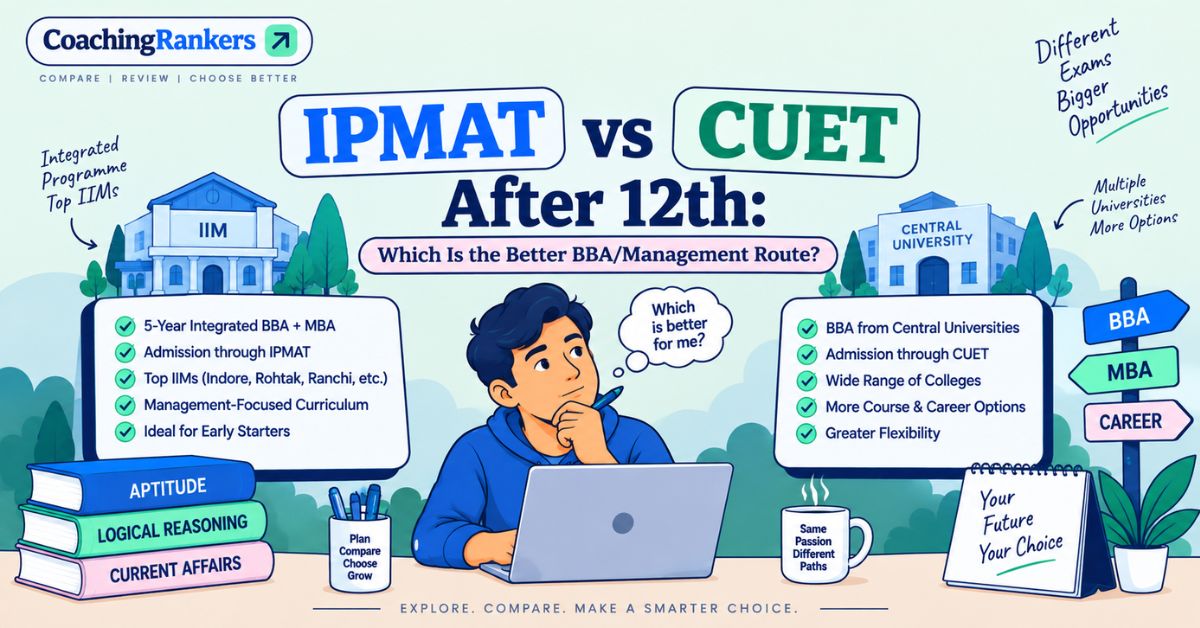
If you've decided management is your path right after Class 12, you've probably run into two exam names again and again: IPMAT and CUET. Both lead to a BBA-type degree. Both are taken right after school. And both get thrown around like they're interchangeable, which they're not.
Here's the real difference in one line: IPMAT gets you into an IIM. CUET gets you into everything else. That single fact should shape most of your decision, but let's break down why, and where each one actually makes sense.
What IPMAT Actually Is
IPMAT stands for Integrated Program in Management Aptitude Test. It's not one exam, it's two separate ones: IPMAT Indore, conducted by IIM Indore, and IPMAT Rohtak, conducted by IIM Rohtak. IPMAT Indore scores are also used by IIM Ranchi, IIFT, and NALSAR's DoMS program, while IIM Rohtak runs its own separate test that only counts for its own IPM seats. There's also JIPMAT, a third track conducted by NTA, which is how you get into IIM Jammu and IIM Bodh Gaya.
What you get if you clear it: a 5-year Integrated Program in Management, which is basically a BBA and MBA fused into one degree, with IIM branding attached to both halves.
Quick facts for 2026:
- IIM Indore conducts the exam, open to anyone who's appeared for or passed Class 12
- It's a 120-minute computer-based test with 100 questions, held across 28 cities
- Testing covers Quantitative Ability and Verbal Ability
- Around 450 seats are expected across IIM Indore and IIM Rohtak for 2026, with IIM Ranchi also accepting IPMAT Indore scores
- General category candidates need 60% in Class 12, SC/ST/PwD candidates need 55%
The seat count matters here. You're competing for roughly 450 seats against tens of thousands of applicants nationally. That's the whole story of IPMAT in one sentence: small funnel, big prestige.
What CUET Actually Is
CUET UG (Common University Entrance Test) is run by NTA and used for undergraduate admission across a huge range of universities, not just for BBA, for almost every UG course you can think of. It covers admissions to central and state universities across India, including Delhi University, BHU, AMU, JNU, TISS, and the University of Hyderabad, and was introduced to standardize UG admissions across central universities under the Ministry of Education.
For BBA specifically, CUET isn't the whole admission, it's the entry ticket. Once you clear it, each university runs its own separate counselling and seat allocation, and eligibility criteria differ university to university.
For example:
- Delhi University requires one language paper plus Mathematics/Applied Mathematics plus the General Test, and Maths is mandatory for BBA at DU
- BHU asks for Class 12 with Commerce, Economics, Maths, Computer Science, Finance, or Financial Markets, with a minimum 50% aggregate and an age cap of 22
- Interestingly, some universities don't require a Commerce background in 12th at all, since CUET BBA testing focuses more on general aptitude, reasoning, English, and quantitative skills than on prior subject knowledge.
The volume of options here is the real story. There are over 230 BBA colleges in India that accept CUET scores, more than 150 private and over 50 government institutions, including names like GGSIPU, BBAU, and Shaheed Sukhdev College of Business Studies.
Side by Side
| IPMAT | CUET (for BBA) | |
|---|---|---|
| Conducted by | IIM Indore / IIM Rohtak | NTA |
| Leads to | 5-year IIM Integrated Program (BBA+MBA) | Standalone 3-4 year BBA |
| Seats available | ~450-700 (across IIMs) | Thousands, across 230+ colleges |
| Competition level | Extremely high, national toppers | High, but with far more entry points |
| Subject background needed | None specific, aptitude-based | Varies by university, some need Maths |
| Degree prestige | Very high (IIM tag from day one) | Depends entirely on the college |
| Career path if you don't clear it | No fallback within this exam | Multiple universities still in play |
So Which One Should You Actually Pick?
Wrong question, honestly. The better question is whether you should attempt one or both, because there's no real conflict in preparing for them at the same time. IPMAT tests quant, verbal, and reasoning. CUET's general test section overlaps with a lot of that. Most serious IPMAT aspirants sit for CUET anyway, as a backup that isn't really a downgrade, just a different tier of college.
Here's how I'd frame it for different kinds of students:
Go all-in on IPMAT if: you're confident on quant and verbal aptitude, you want the IIM brand attached to your degree as early as possible, and you're okay with the fact that even strong students miss out simply because the seat count is so small.
Lean on CUET if: you know exactly which city or university you want (say, Delhi University or a state university close to home), your 12th-grade subjects line up with a university's specific requirement, or you'd rather have a wider spread of options than bet everything on one small funnel.
Do both if: you're serious about a management career and don't want your whole undergrad plan resting on one test day. This is genuinely the most common and sensible path.
One thing worth being honest about: an IIM IPM degree and a BBA from a random CUET-affiliated private college aren't the same currency in the job market. But a BBA from DU, BHU, or a strong state university through CUET is a completely respectable outcome, not a consolation prize. The gap only shows up when you compare IIM-tier IPMAT outcomes against the weaker end of the CUET college list, not against the whole spectrum.
Also Read: CLAT vs CUET-LLB: Which Should You Choose?
Bottom Line
IPMAT is the higher-ceiling, higher-risk exam, narrow, prestigious, IIM-branded from year one. CUET is the wider net, lower single-shot risk, and it opens doors to a genuinely large set of universities, provided you research each institution's subject and score requirements ahead of time since they're not standardized.
If you're prepping for either, this is exactly the kind of decision where a good coaching institute earns its fee, not for the content (most of it's freely available) but for keeping you on a schedule and telling you honestly whether your current level makes IPMAT realistic or whether CUET should be the primary bet.

Written by
Mohit Kumar Rajora
Digital Marketing Manager
Digital Marketing Manager with 6+ years scaling SEO, performance marketing, and organic growth. I help EdTech and SaaS brands rank, convert, and grow - across search engines, Google Ads, Meta Ads, and AI-driven answer platforms.
Experience: Helping EdTech & SaaS Brands Rank, Convert, and Grow | Digital Marketing Manager @ AceIPM | Founder @ SerpMinds